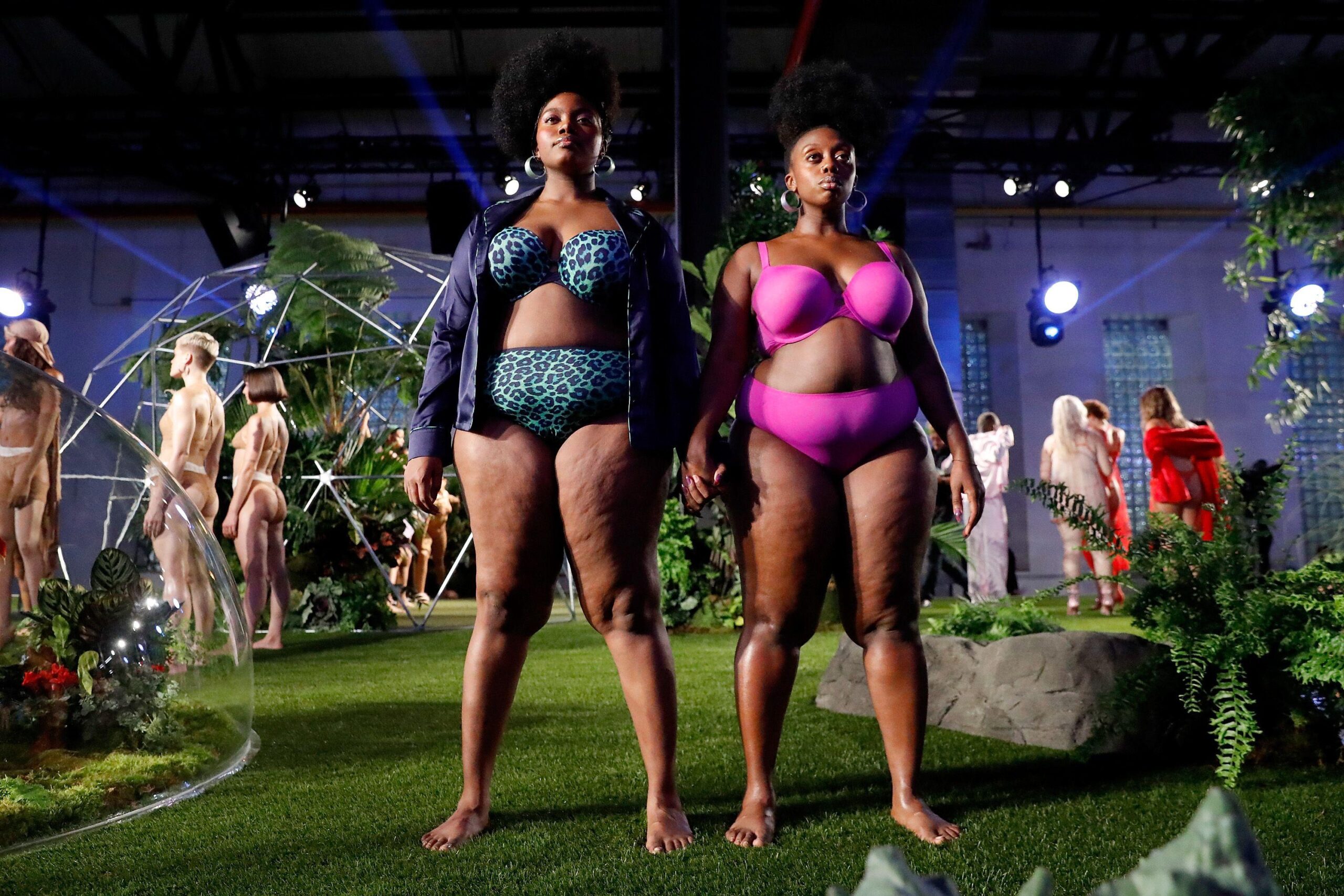
We can all agree that Rihanna changed a lot of things in the beauty industry.
She started with Fenty Beauty and launched 40 foundation shades. That was a big deal. Suddenly, women who had struggled to find their shade had options. Other beauty brands also had to pay attention. And then came Savage X Fenty.
With Savage, we started seeing models we weren’t used to seeing on lingerie runways.
I was used to seeing tall, skinny models. As a matter of fact, I remember going to a modelling agency when I was 19 because I was tall and skinny. I had done a little modelling in high school, and I thought, this is my chance to show out!
Unfortunately for me, I was 5’7. I thought I was 5’10, FYI.
Anyway, when we started watching the Savage X Fenty shows, I saw something different. Different body types. Tall women, bigger women, skinny women, women with different shapes, women with tooth gaps just like me.
I was shocked. I had never seen anything like that before.
And I wasn’t the only one.
At the time, we were also hearing stories about the pressure models faced to maintain certain body sizes. There were conversations about restrictive eating, unhealthy expectations and what women had to put their bodies through to fit into the industry.
It was becoming increasingly difficult to defend an industry that seemed to value one particular body type above everything else.
And as consumers, many of us were becoming less interested in supporting that idea of beauty.
Meanwhile, Rihanna was showing us something different.
Victoria’s Secret had a problem
Victoria’s Secret had spent years selling us a very specific idea of beauty.
The Angels. The wings. The supermodels. The glamorous fashion shows.
And for a long time, it worked.
But the world was changing, and Victoria’s Secret wasn’t changing with it.
Its fashion show was increasingly criticized for its lack of representation and narrow beauty standards. In 2019, the company cancelled the show after years of declining viewership and criticism.
Meanwhile, Savage X Fenty was getting attention for doing things differently.
The problem wasn’t that people suddenly stopped liking beautiful lingerie or glamorous fashion shows. The problem was that Victoria’s Secret seemed to believe there was only one way to sell those things.
And Rihanna had shown the industry that there was another way.
Enter Hillary Super
Here’s where the story gets interesting.
In June 2023, Hillary Super became CEO of Savage X Fenty.
She had an impressive retail background, having previously worked in senior leadership positions at companies including Anthropologie, Gap and American Eagle.
Then, in August 2024, Victoria’s Secret announced that it had appointed her as its new CEO. She officially started on September 9, 2024.
Think about that for a moment.
Victoria’s Secret had just hired the woman who had been running one of its biggest competitors.
Hillary had spent time leading a brand that understood what Victoria’s Secret had been struggling with: how to connect with modern consumers.
Now she was in charge of turning Victoria’s Secret around.
So, what did she do?
1. She brought Victoria’s Secret back to what made it famous
After years of trying to reposition the brand, Victoria’s Secret seemed to have lost some clarity about what it wanted to be.
It had spent so much time trying to respond to criticism that it risked moving too far away from the things people originally associated with it.
Hillary’s approach was different.
Instead of trying to turn Victoria’s Secret into Savage X Fenty, she wanted to bring back its identity.
Glamour. Fashion. Beauty. Sexiness.
But with a different understanding of what sexiness could look like.
Her argument was that sexiness shouldn’t be limited to one particular body type or appearance. It should be something women define for themselves.
I think this was an important decision.
Why compete by becoming another brand when you can give people a reason to love your brand again?
2. She changed how Victoria’s Secret markets itself
This is probably one of the most interesting parts of her strategy.
Victoria’s Secret is an established brand. It already has recognition, history and a huge audience.
But having a famous name doesn’t automatically mean people are paying attention to you.
Hillary started shifting more of the company’s marketing investment towards digital and social media.
This meant more influencer partnerships, more social-first content and more entertainment-led campaigns.
The company also started experimenting with formats such as TikTok Live.
In simple terms, instead of relying mainly on traditional advertising and big campaigns, Victoria’s Secret wanted to show up more often in the places where its customers were already spending their time.
And there’s a difference between those two approaches.
A traditional campaign might get people talking for a week. Social content gives the brand more opportunities to keep the conversation going.
The company has also talked about making its marketing more focused on individual customers, reaching new audiences and bringing existing customers back.
That’s a much bigger job than simply getting people to like a campaign.
3. She turned the fashion show into more than a fashion show
I love this part because it’s a good example of getting more value out of something you already have.
For years, the Victoria’s Secret Fashion Show was a big annual event.
You watched the show, saw the models, talked about the outfits and waited until the following year.
Hillary wanted to change that.
Rather than treating the fashion show as one big night, Victoria’s Secret started building content around it.
Think about everything that happens before the actual show:
- Announcing the models.
- Sharing behind-the-scenes footage.
- Releasing documentaries.
- Creating conversations on social media.
- Getting fans involved.
- Hosting watch parties.
- Livestreaming the event.
In 2026, the company even introduced Angels Among Us, a nationwide search for its next Angel, alongside a documentary following the aspiring models.
Now, instead of having one fashion show that people talk about for a few days, the company has an entire series of marketing opportunities.
And that’s clever.
One event can become weeks or even months of content.
4. She gave Victoria’s Secret and PINK their own identities
Another thing Hillary has been working on is making sure Victoria’s Secret and PINK aren’t trying to speak to everyone in exactly the same way.
Victoria’s Secret is the more glamorous, sophisticated brand.
PINK is younger, more playful and has a different personality.
They have different customers, different products and different reasons people buy from them.
So why should their marketing look identical?
This is something many businesses get wrong. They create one marketing message and try to use it for every customer.
But not everyone wants the same thing.
Understanding who you’re speaking to makes it much easier to create marketing that actually connects.
5. She focused on turning attention into sales
Because here’s the thing.
You can have millions of views, a beautiful campaign and people talking about your brand all over the internet.
But are they buying anything?
Hillary’s strategy has also focused on connecting marketing activity to actual business results.
Victoria’s Secret reported that its Valentine’s Day campaigns generated more than 10.5 billion impressions in 2026, three times the previous year’s figure.
The social media activity around its fashion show documentary also generated more than 36 million views.
And the company has reported growth in new customer acquisition.
The idea is simple: get people talking about the brand, give them a reason to engage, get them interested in the products and make it easier for them to buy.
Marketing should do more than make your brand look popular.
It should help the business grow.
So, did Victoria’s Secret really change?
This is where I think things get interesting again.
Look at the 2026 fashion show.
Victoria’s Secret has brought back much of the glamour and spectacle that made it famous. We’re seeing familiar faces, the Angels and many of the traditional elements of its runway shows.
There is representation, but I don’t think the show has embraced the same broad approach to casting that made Savage X Fenty such a talking point in the first place.
And that raises an interesting question.
Did Victoria’s Secret genuinely change its idea of beauty, or did it simply learn how to market its original idea to a changing audience?
I don’t necessarily think a brand needs to copy its competitor to survive. In fact, I think Hillary understood that Victoria’s Secret didn’t need to become Savage X Fenty.
It needed to become a better version of Victoria’s Secret.
And perhaps that’s the biggest lesson here.
Rihanna showed the industry what consumers were responding to. Victoria’s Secret had to pay attention. Hillary came in and worked on rebuilding the brand, its marketing and its connection with customers.
Your competition doesn’t always have to steal your customers to become a problem. Sometimes, they simply change what your customers expect from you.
And when that happens, you have two choices: pay attention and adapt, or keep doing what you’ve always done and wonder why people aren’t as interested anymore.
Leave a Reply